.png)
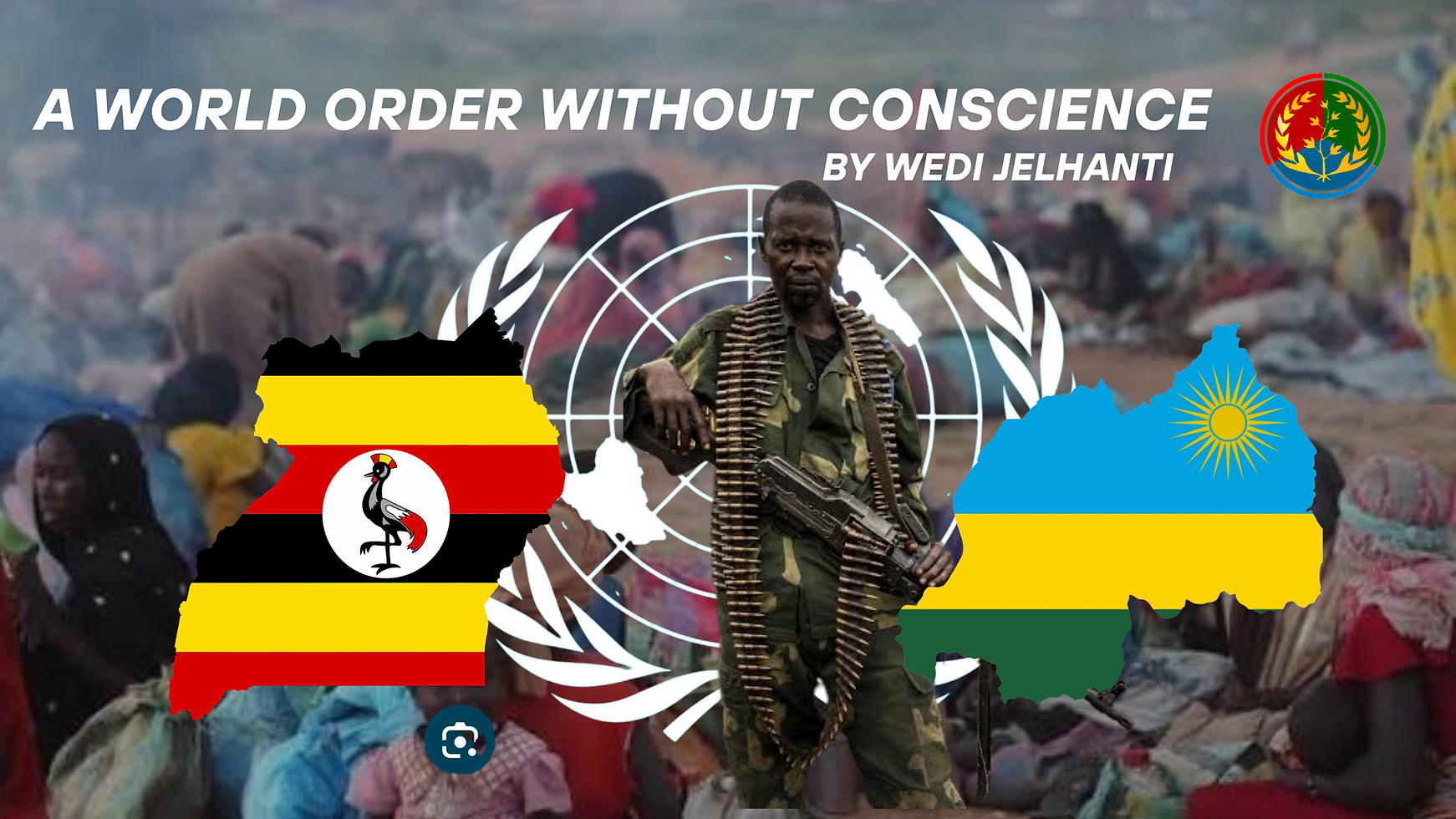
A World Order Without Conscience
By: Wedi Jelhanti
The international system is no longer facing a temporary crisis but a profound moral collapse. While political leaders and global institutions continue to speak the language of human rights, international law, and a rules-based order, entire populations are being destroyed, displaced, and erased with little more than statements of concern. Sudan, Palestine, and Central Africa are not peripheral tragedies. They are indictments of a global order that has abandoned its own principles.
In Sudan, mass violence against civilians has reached catastrophic levels. Ethnically targeted killings, forced displacement, starvation as a weapon, and the systematic destruction of civilian life are no longer disputed facts. Numerous reports describe patterns that meet the gravest thresholds of international crimes. Yet the global response remains paralyzed. Diplomatic caution has replaced moral clarity. Appeals for ceasefires and humanitarian access are repeated while those responsible continue to act without fear of accountability. Silence in the face of such crimes is not neutrality. It is complicity through inaction.
In Sudan, mass violence against civilians has reached catastrophic levels. Ethnically targeted killings, forced displacement, starvation as a weapon, and the systematic destruction of civilian life are no longer disputed facts. Numerous reports describe patterns that meet the gravest thresholds of international crimes. Yet the global response remains paralyzed. Diplomatic caution has replaced moral clarity. Appeals for ceasefires and humanitarian access are repeated while those responsible continue to act without fear of accountability. Silence in the face of such crimes is not neutrality. It is complicity through inaction.
In the Democratic Republic of Congo, one of the deadliest conflicts in modern history continues with little sustained international urgency. Millions have died over decades, not because the conflict is unknowable, but because it is inconvenient. Armed groups operate alongside regional interests and global economic demand for minerals essential to modern technology. Sexual violence, child recruitment, and mass displacement are not accidental byproducts of war. They are structural features of a conflict sustained by external profit and internal fragmentation.
Uganda and Rwanda occupy a particularly revealing position in this crisis. Often described internationally as partners for stability and security, their regional roles raise serious and unresolved questions, especially regarding eastern Congo. These concerns are well documented, yet rarely followed by decisive political consequences. Strategic usefulness appears to outweigh accountability. This reinforces the perception that international justice is not blind, but selective.
At the center of this moral failure stands the United Nations. Created to prevent the very crimes now unfolding, the organization has become constrained by veto power, political bargaining, and institutional inertia. In practice, the UN often reflects global power hierarchies rather than universal principles. Human rights mechanisms are activated where political cost is low and muted where power is concentrated. Immunity frameworks and internal investigations frequently shield institutions and individuals from meaningful scrutiny. The result is a growing belief that the system exists to manage crises, not to resolve them.
This pattern is not limited to armed conflict. It mirrors broader structures of elite impunity. Across the global system, political, economic, and institutional power increasingly functions without effective accountability. When justice becomes negotiable, abuse becomes systemic. When responsibility is deferred indefinitely, violence becomes normalized.
The consequences are severe. Trust in international institutions is collapsing, particularly across the Global South. Multilateralism is losing legitimacy. Populations subjected to selective justice no longer believe in international law as a protective force. This erosion fuels radicalization, instability, and rejection of global norms. A world order that applies principles selectively cannot sustain peace.
What unites Sudan, Palestine, and Central Africa is not geography or culture, but exposure to a system that prioritizes power over principle. These crises reveal that the greatest threat to global stability is not the absence of rules, but the selective enforcement of them. As long as accountability depends on political alignment rather than human suffering, the language of human rights will remain empty.
A genuine transformation requires more than reform statements or institutional adjustments. It demands equal standards, real consequences, and the courage to confront abuse even when it implicates powerful actors. Without this break from hypocrisy, the international order will continue to decay, and the promise of justice will remain an unfulfilled declaration rather than a lived reality.



Comments