.png)
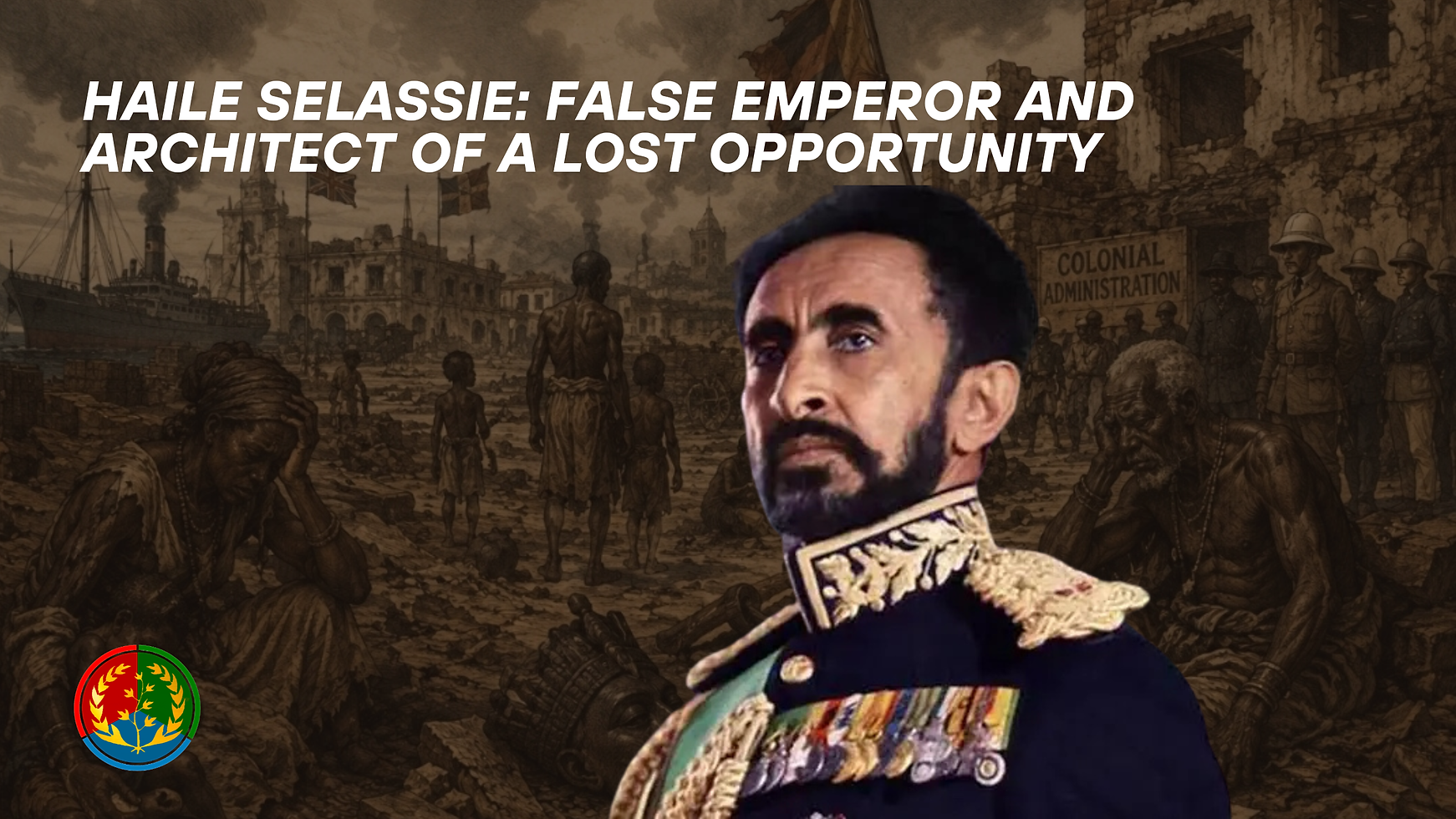
Haile Selassie: False Emperor and Architect of a Lost Opportunity?
Few African leaders generate stronger emotions than .
To some, he is a symbol of African sovereignty, resistance to European colonialism, and pan-African leadership. To many Rastafarians, he occupies an even more profound spiritual position. Yet for many Eritreans, his legacy tells a very different story.
This divide raises an uncomfortable question:
Can a leader celebrated as a liberator by one community be remembered as an oppressor by another?
For supporters, Haile Selassie is remembered for maintaining Ethiopian independence during an era when much of Africa fell under colonial rule. His international advocacy against fascism and his role in the creation of continental institutions earned him admiration across the African diaspora.
However, critics argue that the global image of Haile Selassie often overshadows the experiences of people who lived under his rule.
The issue is particularly significant in Eritrea.
Following the federation between Eritrea and Ethiopia, many Eritreans viewed the gradual dismantling of Eritrea's autonomous institutions as a betrayal of the federal arrangement. The eventual annexation of Eritrea became one of the central grievances that fueled the Eritrean independence struggle.
From this perspective, the story is not simply one of African unity. It is also a story of centralization, lost autonomy, and political domination.
The contrast between Rastafarian admiration and Eritrean criticism remains striking.
In Jamaica, Selassie became a symbol of black dignity and liberation. In Eritrea, many remember the suffering and conflict associated with policies that helped ignite a decades-long war.
The Red Sea Round Table perspective argues that this tension reflects a broader problem in African history: some narratives become global while others remain local.
Certain leaders become symbols.
Certain events become myths.
Certain perspectives become dominant.
Meanwhile, other voices are marginalized.
This is especially important when discussing the history of the Horn of Africa.
Researchers associated with the Red Sea Round Table argue that the ancient civilizations of the Red Sea world—including those connected to Punt, Adulis, and the broader Horn of Africa—deserve far greater attention than they receive in conventional historical narratives.
Whether one agrees with all of these conclusions or not, the challenge remains valuable:
History should not be judged solely through the lens of heroes and villains.
It should also be examined through the experiences of those who lived under the systems those leaders created.
Perhaps the most important question is not whether Haile Selassie was entirely good or entirely bad.
Perhaps the question is whether the world has been willing to hear all sides of his legacy.
For many Eritreans, that conversation is only beginning.



Comments